

Study in the USA
The USA offers a wide choice of accredited colleges and universities and a flexible degree system. This page explains how to choose a school, what it costs, how the F-1 student visa works in 2026 and what work is allowed after you graduate.
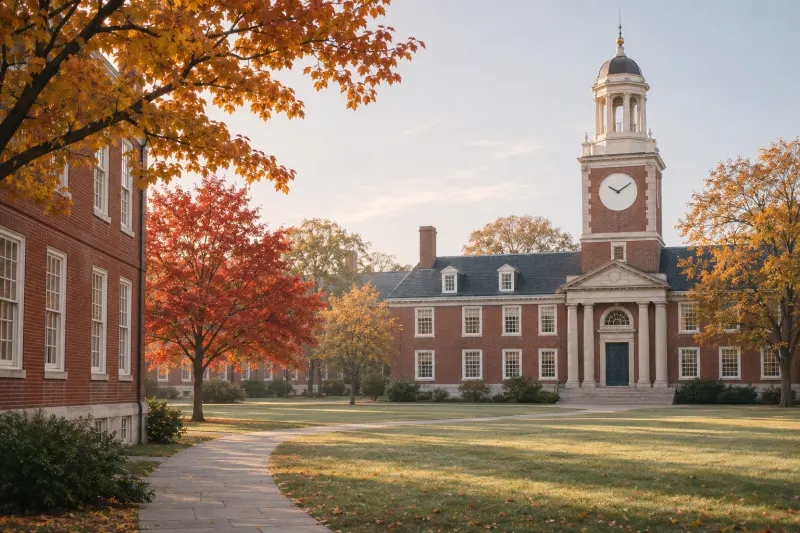
To study in the USA, international students need an offer from a school certified by the Student and Exchange Visitor Program (SEVP), a Form I-20 from that school and an F-1 student visa. Admission, the I-20 and the visa interview can take many months, so start early.
Why study in the USA
- Choice: community colleges, public universities and private universities, in big cities and small towns.
- Flexible degrees: bachelor's students often take general subjects first and choose a major later.
- Practical training: eligible F-1 graduates may work in their field for up to 12 months through Optional Practical Training (OPT), or 36 months after a STEM (science, technology, engineering and mathematics) degree.
Types of US colleges and universities
Community colleges offer 2-year associate degrees. In a "2+2" pathway, you study two years at a community college, then transfer to a university to finish a bachelor's degree. Public universities are state-funded, and international students usually pay the out-of-state rate or more. Private universities usually cost more. Read more on our US education system page.
Good to know: Only an SEVP-certified school can issue a Form I-20. Before you apply, check the school on the official Study in the States school search (opens in a new tab) and confirm its accreditation.
When you can start
Fall (August or September) is the main intake, with applications usually due between November and March. Many universities also offer a Spring intake in January, and some offer Summer starts. Deadlines differ for each program.
The F-1 student visa in 2026: what has changed
As at November 2026, plan for these changes:
- Interviews: since 2 September 2025, almost all student visa applicants need an in-person interview. You should generally apply at a US embassy or consulate in your country of nationality or residence.
- Online presence checks: since 18 June 2025, F, M and J applicants are asked to set their social-media profiles to public. The DS-160 visa application form also asks for every social-media name you used in the last 5 years. List them all honestly.
- Travel restrictions: from 1 January 2026, presidential proclamations suspend new student visas for nationals of 38 countries (19 fully and 19 partly restricted). India, Nepal, Sri Lanka, Pakistan, Bangladesh and the Philippines are not on these lists as at November 2026. The lists can change.
- Length of stay: students are still admitted for "duration of status" (as long as they study and keep their status). A rule replacing this with a fixed stay of up to 4 years was blocked by a federal court on 14 September 2026. The government has appealed.
Read more on our F-1 student visa page.
How much it costs
| Cost | Amount |
|---|---|
| Public 4-year university, out-of-state tuition and fees | USD 32,730 a year on average (2026-27) |
| Private nonprofit 4-year university, tuition and fees | USD 46,350 a year on average (2026-27) |
| SEVIS I-901 fee (F-1) | USD 350 (since 24 June 2019) |
| Visa application (MRV) fee | USD 185 (since 17 June 2023) |
| Living costs | Set by each school on its I-20 cost estimate |
For proof of funds, you must show at least the school's estimated cost for the first year, as listed on your I-20, and funding for later years. A July 2025 US law also created a "visa integrity fee" that may apply in future, so check current fees on the US State Department website. See our cost of studying and living in the USA page for more detail.
Work during and after study
During term you can work on campus for up to 20 hours a week, and full time during official breaks. Off-campus work is only allowed through Curricular Practical Training (CPT), OPT or a rare economic hardship permit.
OPT gives up to 12 months of work related to your major for each higher degree level. You apply on Form I-765 from 90 days before to 60 days after your program ends. The fee is USD 470 online or USD 520 on paper (since 1 April 2024). STEM OPT adds 24 months for degrees on the official STEM list. You need an employer enrolled in E-Verify and a Form I-983 training plan. A USD 70,000 fee for initial OPT was proposed on 8 October 2026. It is not in effect as at November 2026.
Important: The F-1 is a temporary (nonimmigrant) visa. At your interview you must show that you plan to study, not to settle permanently. Do not choose a school mainly for "Day 1 CPT" work. SEVP guidance from August 2026 reads the CPT rules narrowly.
Steps to study in the USA
- Choose a course and school Check SEVP certification, accreditation, total cost and English entry scores.
- Take your tests Most schools accept TOEFL iBT, IELTS Academic or the Duolingo English Test, and many accept PTE Academic. Some also ask for the SAT, GRE or GMAT.
- Apply and accept an offer Send transcripts, essays and references on time.
- Get your I-20 The school issues it after you show proof of funds.
- Pay the fees and book an interview Pay the SEVIS I-901 fee only on the official fmjfee.com site. Complete the DS-160, pay the visa application (MRV) fee and book your appointment.
- Attend your visa interview Bring your I-20, fee receipts, financial documents and academic records.
- Travel New students can enter the USA up to 30 days before the program start date on the I-20.
How Immi Solution helps
Our education counsellors help you compare US schools, prepare applications and get ready for your F-1 interview. Our English test coaching can help you prepare. We are not US attorneys and do not give US immigration legal advice. For that, we refer you to a licensed US immigration attorney.
Plan your studies in the USA
- F-1 student visa I-20, SEVIS fee, DS-160, interview, work rules and OPT for the US student visa.
- US education system College types, degree levels, credits and GPA, graduate school, accreditation and intakes in the USA.
- Cost of study and living US tuition, living costs, I-20 proof of funds, visa fees and ways to lower the total cost.
- Popular courses Computer science, data, business analytics, engineering and health courses in the USA, and how STEM OPT works.
Questions people ask
Can I study in the USA from India?
Yes. Indian citizens can apply for an F-1 student visa, and India is not on the US travel restriction lists as at November 2026. The same applies to Nepal, Sri Lanka, Pakistan, Bangladesh and the Philippines. You need an offer and an I-20 from an SEVP-certified school, and you will usually attend your interview at a US embassy or consulate in India.
How much money do I need to show for the I-20?
There is no fixed government amount. The school sets an estimated cost of attendance for one academic year, covering tuition, fees and living costs, and you must show funds for at least that amount. Common evidence includes bank statements, education loan letters, sponsor documents and scholarship letters. You also need to show that money will be available for later years.
Can I work while studying in the USA?
Yes, with limits. F-1 students can work on campus for up to 20 hours a week during term and full time during official breaks. Off-campus work needs authorisation through CPT, OPT or an economic hardship permit. Working without authorisation can end your student status, so check with your school's Designated School Official (DSO) before you accept any job.
Is there a USD 70,000 OPT fee now?
No. On 8 October 2026 the US government published a proposed rule for a USD 70,000 fee for initial OPT and USD 30,000 for later OPT, such as a STEM extension, paid through the school. It is not in effect as at November 2026, and the current OPT and STEM OPT rules have not changed. Check the Study in the States website for updates.
Do I need the SAT, GRE or GMAT to study in the USA?
It depends on the school and program. Many colleges have been test-optional since 2020, but some highly selective universities require the SAT or ACT again. Many master's programs now waive the GRE or GMAT, while others still ask for it. Each school also sets its own minimum English score. Check the admissions page of every program on your list before you book a test.
Official sources
We check this page against the official information below and last reviewed it on 14 November 2026. Rules, fees and processing times change, so confirm the current position before you apply.
- Proposed rule establishing fees for Optional Practical Training (October 2026) — Study in the States (US Department of Homeland Security) (opens in a new tab)
- I-901 SEVIS fee — US Immigration and Customs Enforcement (opens in a new tab)
- Student visa — US Department of State, Bureau of Consular Affairs (opens in a new tab)
- Proclamation restricting and limiting entry of foreign nationals (19 December 2025) — Federal Register (opens in a new tab)
- Optional Practical Training (OPT) for F-1 students — US Citizenship and Immigration Services (opens in a new tab)
- Trends in College Pricing 2026 highlights — College Board (opens in a new tab)

